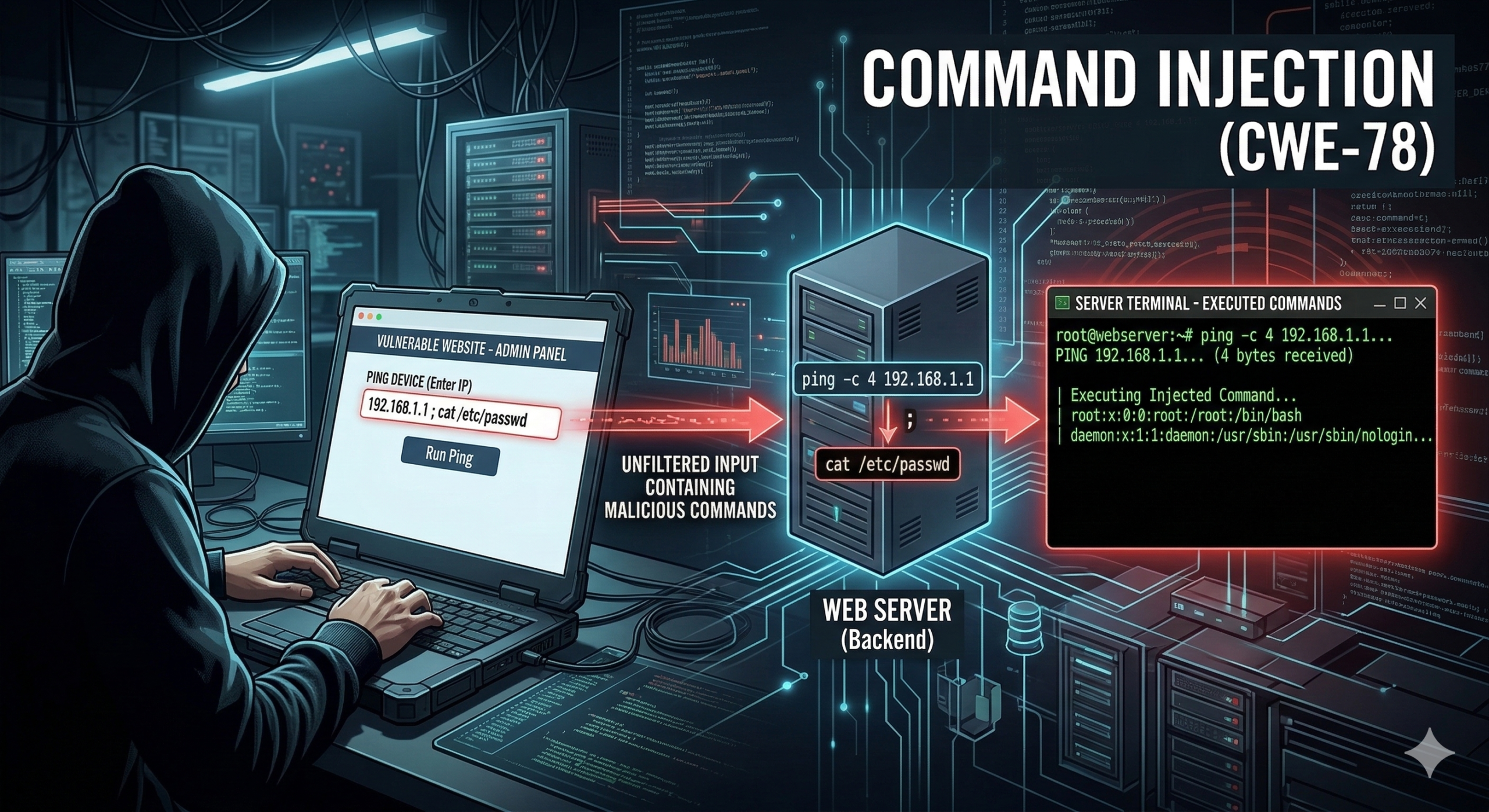
Operating System (OS) command injection, often called shell injection, is a devastating vulnerability that occurs when an application passes unsafe, user-supplied data directly to a system shell without sufficient validation. While other vulnerabilities like code injection limit an attacker to the application’s specific programming language, command injection bypasses the application runtime entirely. It drops the attacker directly into the host operating system, which can quickly lead to a total system compromise.
How the Attack Works The core of the issue lies in how system shells interpret special characters. Attackers will take an ordinary input field and inject shell metacharacters—such as semicolons (;), pipes (|), or logical ANDs (&&)—to break out of the intended command and append entirely new, malicious commands.
Depending on how the application is built, attackers leverage these vulnerabilities in different ways:
- Verbose Injection: The application executes the command and immediately displays the output (like a list of passwords, system configurations, or user data) directly in the HTTP response.
- Blind Injection: When the application suppresses the output, attackers rely on inference. They can inject time-delay commands (like
pingorsleep) to confirm the vulnerability based on how long the server takes to respond. To actively extract data without seeing the output, they utilize Out-of-Band (OOB) techniques, forcing the compromised server to transmit the stolen information to an external server via disguised DNS requests.
How to Prevent It Securing your applications requires an architectural shift rather than just filtering out “bad” inputs. Here are the most effective strategies:
- Use Native APIs: The absolute best defense is to avoid invoking the system shell entirely. Instead of calling external system commands (like
pingormail), use the built-in library functions provided by your programming language. - Enforce Parameterization: If calling an external binary is absolutely unavoidable, you must use parameterized execution. This ensures the operating system explicitly separates the executable command from the user’s data, treating the input purely as literal text strings rather than executable shell instructions.
- Strict Allowlisting: Never rely on “denylists” that simply try to filter out dangerous characters. Attackers constantly invent new ways to obfuscate their payloads using backslashes, variable expansion, or alternative spacing. Instead, implement a strict positive security model (allowlisting) that only accepts known, safe input patterns that conform to expected lengths and types.